Millman's Theorem Formula. Millman's theorem applicable to voltage sources. Millman's theorem states that if there are voltage sources v1, v2,…… vn with internal resistances r1, r2,….rn, respectively, are in parallel, then these sources are replaced by single voltage source v' in. Specifically, millman's theorem is used to compute the voltage at the ends of a circuit made up of only branches in parallel. Millman's theorem acts as a very strong tool in case of simplifying the special type of complex electrical circuit. Millman's theorem states that when a number of voltage sources are in parallel having internal resistance,the arrangement can be explanation of millman's theorem. Equivalent millman circuit formulas, example. Parts of this equation seem familiar to equations we've seen before. Millman's theorem states that when there are several voltage sources connected in parallel, each in series with a resistance (internal resistance ri), the array can be replaced by a single voltage source (vm) in series with an equivalent resistance (rm). Millman's theorem is a theorem which helps in simplifying electrical networks with a bunch of parallel branches. It was invented by the russian born, american engineer jacob millman. In electrical engineering, millman's theorem (or the parallel generator theorem) is a method to simplify the solution of a circuit. It is named after jacob millman, who proved the theorem. Millman's theorem can be used to find the potential difference between two points of a network which contains only. Assuming a dc network of numerous parallel voltage sources with internal resistances supplying power to a load resistance rl. Millman's theorem or parallel generator theoremtopics discussed:1) the statement of millman's theorem.2) the derivation of millman's theorem.
Millman's Theorem Formula : Millman S Theorem Electrical And Electronics Engineering
A Media To Get All Datas In Electrical Science Millman S Theorem. Millman's theorem states that when there are several voltage sources connected in parallel, each in series with a resistance (internal resistance ri), the array can be replaced by a single voltage source (vm) in series with an equivalent resistance (rm). It is named after jacob millman, who proved the theorem. It was invented by the russian born, american engineer jacob millman. Millman's theorem states that if there are voltage sources v1, v2,…… vn with internal resistances r1, r2,….rn, respectively, are in parallel, then these sources are replaced by single voltage source v' in. Parts of this equation seem familiar to equations we've seen before. Millman's theorem is a theorem which helps in simplifying electrical networks with a bunch of parallel branches. Millman's theorem states that when a number of voltage sources are in parallel having internal resistance,the arrangement can be explanation of millman's theorem. In electrical engineering, millman's theorem (or the parallel generator theorem) is a method to simplify the solution of a circuit. Millman's theorem can be used to find the potential difference between two points of a network which contains only. Specifically, millman's theorem is used to compute the voltage at the ends of a circuit made up of only branches in parallel. Assuming a dc network of numerous parallel voltage sources with internal resistances supplying power to a load resistance rl. Millman's theorem acts as a very strong tool in case of simplifying the special type of complex electrical circuit. Millman's theorem applicable to voltage sources. Equivalent millman circuit formulas, example. Millman's theorem or parallel generator theoremtopics discussed:1) the statement of millman's theorem.2) the derivation of millman's theorem.
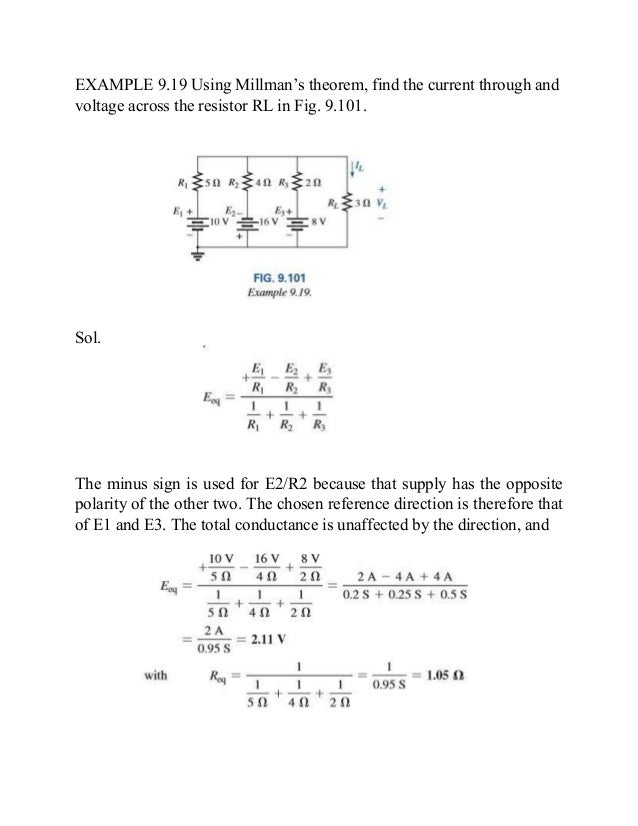
Concept of millmans all about the parallel configuration cannot have more than one source in a branch cannot have more than one resistance in a branch.
Millman's theorem states that if there are voltage sources v1, v2,…… vn with internal resistances r1, r2,….rn, respectively, are in parallel, then these sources are replaced by single voltage source v' in. How and when to apply this theorem with its statement is given. It is named after jacob millman, who proved the theorem. Millman's theorem states that when a number of voltage sources are in parallel having internal resistance,the arrangement can be explanation of millman's theorem. Notes 6 a very common mistake i've seen students make is to disregard polarities when using millman's theorem. The binomial theorem formula helps us to find the power of a binomial without having to go through the tedious process of multiplying it. Specifically, millman's theorem is used to compute the voltage at the ends of a circuit made up of only branches in parallel. So i missed the lecture we had on millman's theorem and i have tried to do a bit of research on it but i find several different versions of it. I have tutorial papers to do but they work on the basis of you knowing how to do them already basically practise papers. Specifically, millman's theorem is used to compute the voltage at the ends of a circuit made up of only branches in parallel. There is no formula for a theorem. Parts of this equation seem familiar to equations we've seen before. Entre los extremos de un circuito. Millman's theorem acts as a very strong tool in case of simplifying the special type of complex electrical circuit. If this appears to be a common problem in your. Here again is our example circuit used for the last two analysis. Millman's theorem states that if there are voltage sources v1, v2,…… vn with internal resistances r1, r2,….rn, respectively, are in parallel, then these sources are replaced by single voltage source v' in. It is easy to apply as it doesn't require. Assuming a dc network of numerous parallel voltage sources with internal resistances supplying power to a load resistance rl. In electrical engineering, millman's theorem1 is a method to simplify the solution of a circuit. Millman's theorem applicable to current sources. How does ii turn up in this formula? George pick created pick's theorem. Millman's theorem is a theorem which helps in simplifying electrical networks with a bunch of parallel branches. Examples demonstrate the accuracy and efficiency of application of the generalized millman's formula. It is named after jacob millman, who proved the in electrical engineering, millman's theorem (or the parallel generator theorem) is a method to simplify the solution of a circuit. Millmans theorem, millmans theorem example, millman theorem formula. Millman's theorem for ac networks statement: How and when to apply this theorem with its statement is given. Millman's theorem states that when there are several voltage sources connected in parallel, each in series with a resistance (internal resistance ri), the array can be replaced by a single voltage source (vm) in series with an equivalent resistance (rm). The most succinct version of this formula is shown immediately below.
